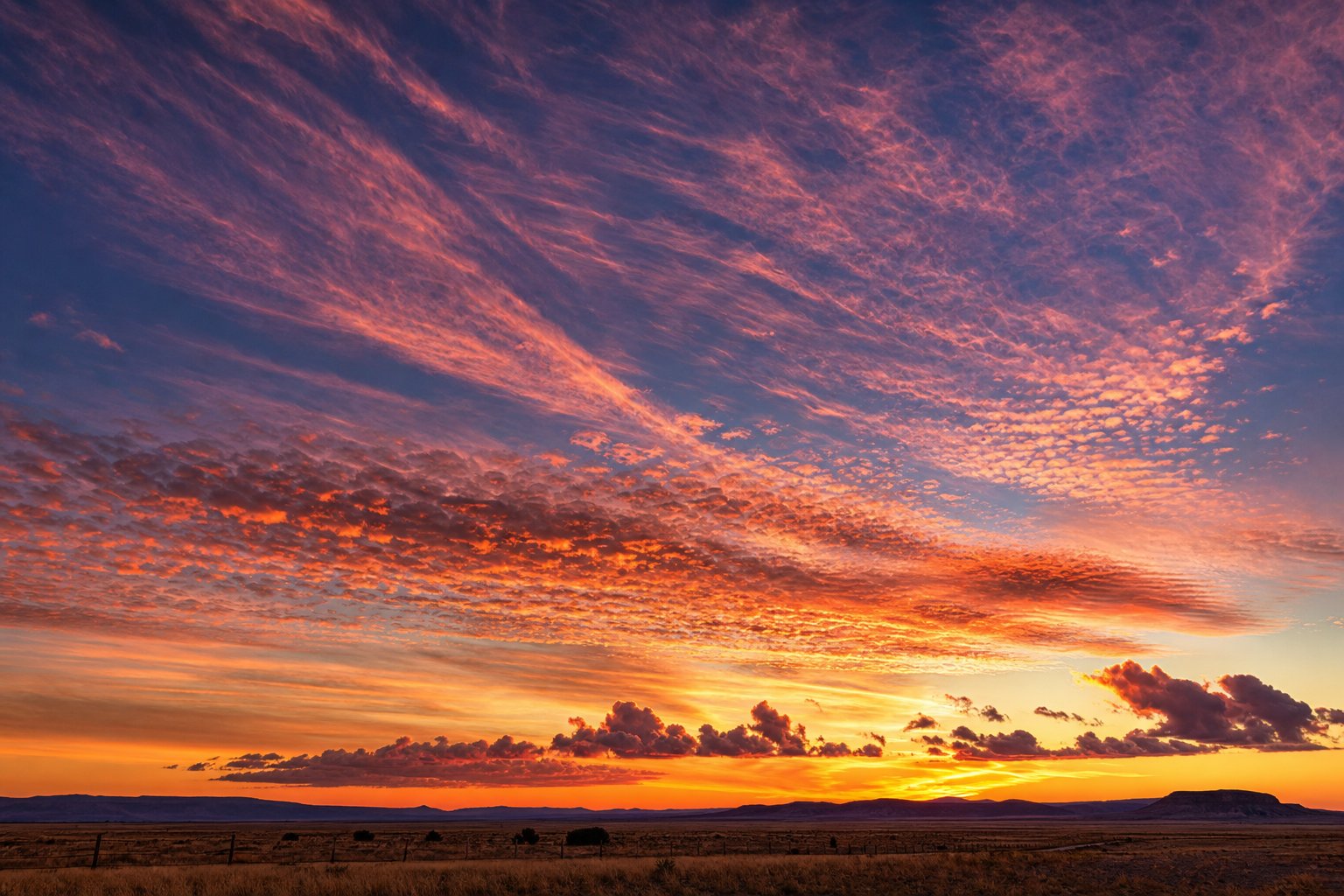
A clear sky makes for a clean sunset, but rarely a memorable one. The most dramatic color almost always needs clouds, just the right kind, at the right height, in the right place. Once you learn to read the clouds overhead in the afternoon, you can make a fair guess about whether the evening will deliver fiery color or fizzle into a dull gray fade.
The key idea is simple. Clouds act as a screen for the low sun to paint on. High and mid-level clouds catch warm light from below and glow, while a thick low blanket simply blocks it. Here is how to tell them apart.
Why Clouds Make or Break the Color
As the sun drops toward the horizon, its light travels through more of the atmosphere, which scatters away the blue and leaves the reds and oranges. That warm light then shoots almost horizontally and lights the underside of any clouds in its path. Clouds high enough to still be in sunlight after the ground has fallen into shadow are what catch fire with color.
The catch is the western horizon. Even perfect clouds overhead need a gap near the horizon for the sun to slip its light through. A solid wall of cloud in the west blocks that final beam and leaves your glowing clouds dark.
High Clouds Are Your Best Friend
The wispy, feathery clouds high in the sky are the ones that produce the richest sunsets. Made of ice crystals far above the ground, they stay lit long after lower clouds have gone dark, and their thin, broken texture lets color spread across them.
- Thin streaks and feathers high overhead are a strong sign of good color to come.
- A delicate, rippled sheet high in the sky often lights up in patches across the whole dome.
- Patchy mid-level clouds with gaps can glow strongly and add depth and shape.
Low Thick Clouds Usually Spell Trouble
A low, gray, featureless overcast layer is the enemy of a colorful sunset. It sits below the sun's final light, so instead of catching warm tones it just turns the sky a flat, dim gray. Heavy storm clouds piled up in the west work the same way, sealing off the horizon.
There are exceptions. If a low deck is breaking up, or if there is a clear strip right at the western horizon under the cloud, the sun can fire underneath and light the whole layer from below for a brief, intense show. Watch the western edge as the hour approaches.
The 30 to 70 Percent Sweet Spot
Total cloud cover matters as much as cloud type. A completely clear sky has nothing to color, and a fully overcast one blocks everything. The best sunsets tend to fall in between, with roughly a third to two thirds of the sky carrying clouds. That leaves enough open horizon for light to get through and enough clouds to catch and hold the color.
- Aim for a sky that is partly covered, not empty and not solid.
- Check that the western horizon has a clear or broken gap for the light.
- Scattered high clouds over a mostly open sky is close to ideal.
Reading the Afternoon for Tonight
You can start judging by mid-afternoon. Note whether the high feathery clouds are moving in or clearing out, and watch the western sky for a thickening wall or a widening gap. Humidity and haze also dull the color, so a crisp, clean day after a passing front, with fresh high clouds drifting in, often sets up beautifully. A muggy, hazy afternoon tends to mute even a promising sky.
Wind direction offers a clue too. Clouds approaching from the west may arrive in time to block the sun, while clouds clearing toward the east can leave the western horizon open just as the sun reaches it.
Conclusion
Predicting a good sunset comes down to reading the clouds. High, thin, broken clouds are the ones that glow, while low solid overcast smothers the light. You want partial cover, somewhere around a third to two thirds of the sky, and above all a clear or broken gap along the western horizon for the sun's last light to reach through. Start watching in the afternoon, and you will know when to grab your camera and when to stay home.