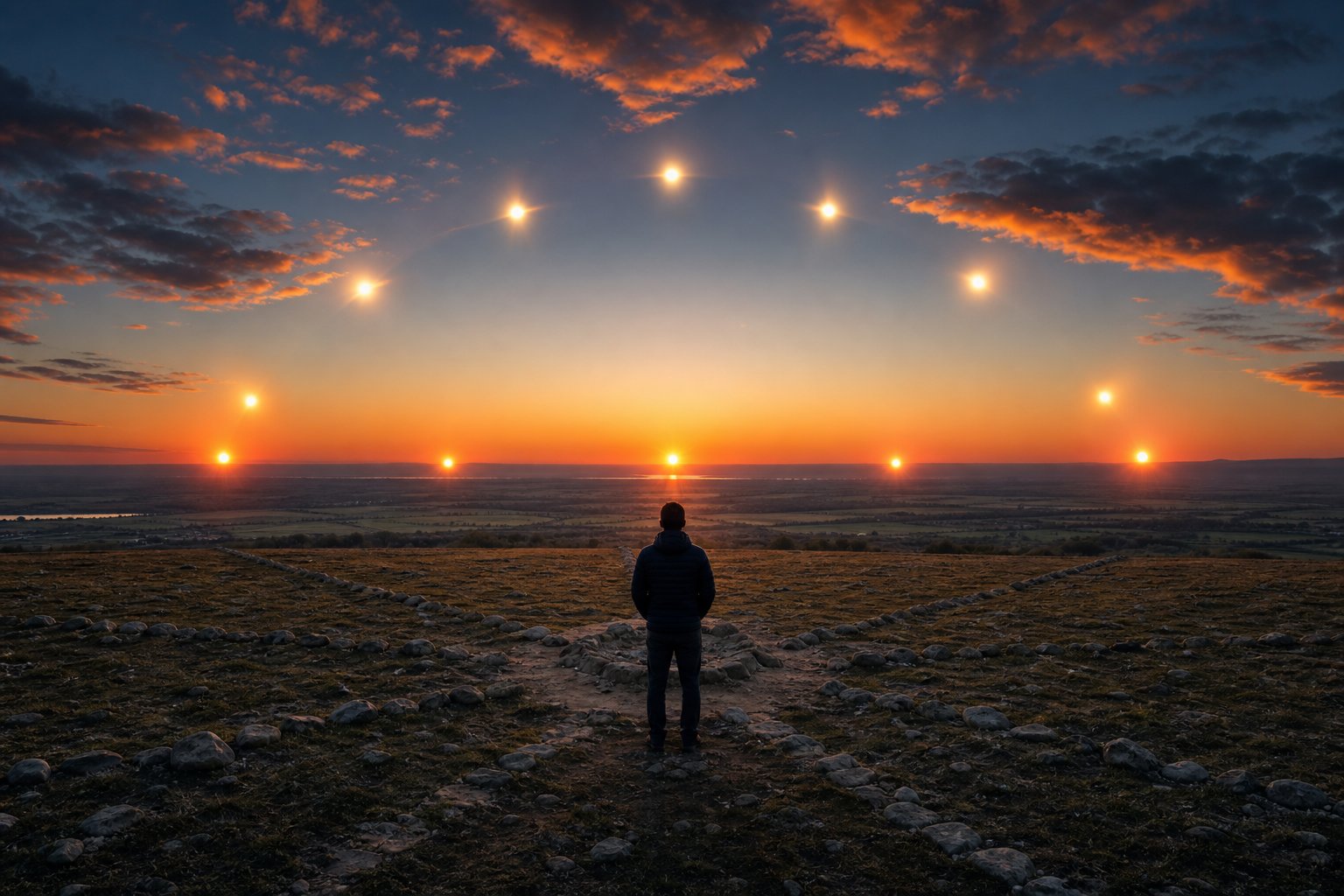
If you have ever set up to watch a sunset from the same spot months apart and found the sun in a noticeably different place, you have seen the seasons at work. The sun does not rise due east and set due west except on two days a year. Where it appears on the horizon shifts steadily through the year, and knowing that pattern lets you point yourself in the right direction long before the light arrives.
Understanding this saves you from arriving at a viewpoint only to find the sun setting behind a hill or out of frame. Here is how the sun moves and how to use it.
Why the Sun Wanders Along the Horizon
The Earth is tilted on its axis as it orbits the sun. That tilt means each hemisphere leans toward the sun for part of the year and away for the rest. From the ground, this shows up as the sun rising and setting at different points along the horizon and climbing to different heights at midday depending on the date.
The movement is gradual day to day but adds up over weeks. Near the solstices the shift slows almost to a stop, which is where the word solstice, meaning sun standing still, comes from. Near the equinoxes the position changes fastest.
The Four Markers Worth Knowing
Four dates anchor the whole cycle, and remembering them gives you a mental map of the year.
- The spring equinox, around late March, when the sun rises due east and sets due west.
- The summer solstice, around June, when sunrise and sunset reach their farthest point toward the north.
- The autumn equinox, around late September, again due east and due west.
- The winter solstice, around December, when sunrise and sunset swing farthest toward the south.
Between these markers the sun slides smoothly from one extreme to the other and back, so any date falls somewhere predictable along that arc.
How Far the Sun Swings Depends on Where You Live
The size of this swing is not the same everywhere. Near the equator the sun stays close to due east and west all year and climbs nearly overhead, so the seasonal shift is small. The farther you travel toward the poles, the wider the swing becomes. At high latitudes the difference between a summer and winter sunset point can span a huge stretch of the horizon, and the sun stays much lower in the sky even at noon in winter.
This is why the same advice cannot apply everywhere. A coastline that delivers a sun setting straight over the water in summer might put the sun far down the beach in winter.
Which Way to Face Through the Year
For practical planning in the northern hemisphere, think of it this way. In summer, face toward the northwest for sunset and northeast for sunrise. In winter, shift toward the southwest and southeast. At the equinoxes, straight west and east are correct. In the southern hemisphere the seasons flip, so summer sends the sun toward the southwest at sunset.
- Pick a viewpoint with an open horizon in the direction the sun will actually be, not where it was last season.
- For a sunset behind a specific landmark, scout the season when the sun lines up with it.
- Remember the sun sits lower and the light lingers longer near the winter solstice.
Tools That Take Out the Guesswork
You do not have to track this in your head. Several free phone apps and websites show the exact sunrise and sunset bearing for any location and date, often drawn as a line over a map or as an augmented reality overlay you point at the sky. A simple compass works too once you know the rough direction to expect. Checking the day before a shoot tells you precisely where to stand.
Putting It to Use
Once you know that the sun drifts north in summer and south in winter, you stop being surprised. You can plan a sunset that aligns with a bridge in October, return to the coast when the sun finally sets over open water, or simply choose the right side of a building for evening light. The sky stops feeling random and starts following a schedule you can read.
Conclusion
The sun's place on the horizon is governed by the Earth's tilt, sweeping from its northern extreme at the summer solstice to its southern one at the winter solstice and crossing due east and west at the equinoxes. How wide that sweep feels depends on your latitude. Learn the four markers, know which way to face for your hemisphere and season, and lean on a sun-position app to confirm, and you will always be pointed the right way when the light turns golden.